
Prime Minister Narendra Modi and United States President Joe Biden have expressed 'deep pride' and appreciation about their nations' close cooperation to fight the deadly COVID-19 pandemic, as they noted that all sections of the society were mobilised in unprecedented ways to share emergency relief supplies during each country's times of need.

India has so many relationships, such an ability to communicate and find touch points with different countries and regions.

The Nuclear Security Summit is being hosted by US President Barack Obama on March 31 and April 1.

Prime Minister Narendra Modi has met his Australian counterpart Scott Morrison in Washington, DC, ahead of the first in-person Quad meeting to be hosted by US President Joe Biden and discussed a broad range of issues of bilateral, regional and global importance, including the Indo-Pacific.

Prime Minister Narendra Modi will leave for the Belgian capital as part of a three-nation tour during which he will attend the Nuclear Security Summit in Washington and visit.

The jury is still out on whether the Obama-Sharif summit managed to repair the trust deficit and mutual suspicions. But if pleasantries and cordiality was the measure of this summit, it receives a resounding A+ grade, says Aziz Haniffa

Although the pact would focus mainly on the Pacific and the South China Sea region, any action designed to deter China with or without New Delhi's active participation is a welcome move, notes Commodore Venugopal Menon (retd).
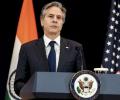
The 2+2 was attended by Secretary of State Antony Blinken and Secretary of Defence Lloyd Austin and their Indian counterparts S Jaishankar and Rajnath Singh respectively.
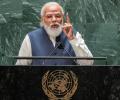
Addressing the 76th UNGA session in New York, Modi called for ensuring that no country 'tries to take advantage of the delicate situation in Afghanistan and use it for its own selfish interests'.

Proliferation and potential use of nuclear weapons pose the most dangerous threat to global security and peace, US President Barack Obama has said.
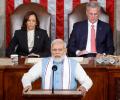
Here's the full text of Prime Minister Narendra Modi's address to a joint session of the United States Congress, delivered on Thursday.

Pakistan Prime Minister Yousuf Raza Gilani is unlikely to meet his Indian counterpart Dr. Manmohan Singh in Washington, where they are scheduled to attend the Nuclear Security Summit in Washington on April 12 and 13.

'The coming two months could unfold unpredictable results or unpredictable consequences or both at the same time,' says Rajaram Panda.
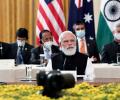
"In all the meetings the Prime Minister had, beginning with US leadership, there was a suo moto recognition of the concerns that Pakistan represents as a country that has in many senses both supported and nurtured cross-border terrorism, including in Afghanistan and from Afghanistan," he said.

The virtual meeting between the two leaders came in the midst of some disquiet in Washington over India's position on the Ukraine crisis as well as its decision to procure discounted Russian oil.
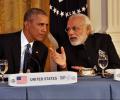
After the three bilateral meetings, Modi would participate in the three separate sessions of the Nuclear Security Summit, which kicked off with a White House dinner on Thursday night.

United States President Barack Obama and Prime Minister Narendra Modi have made the first use of the secure hotline set up between Washington and New Delhi as they reviewed progress on key areas of cooperation and discussed global issues ahead of the upcoming G-20 summit.
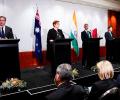
The foreign ministers of the Quad grouping of India, the US, Australia and Japan on Friday held extensive talks in Melbourne amid escalating tension between Russia and NATO countries over Ukraine, the Afghan crisis and increasing concerns over China's "coercion" in the Indo-Pacific region.

Prime Minister Manmohan Singh is expected to undertake a six-day visit to the United States from September 20, during which he will have a bilateral meeting with President Barack Obama in Washington besides attending the United Nations General Assembly in New York.
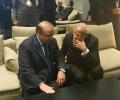
How the two South Asian neighbours will interact with each other in the coming months will be decided by the two prime ministers in Washington.
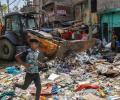
Many of the stories, the pictures going out of India worldwide lately with these provocative processions, taunting of Muslims, bulldozers targeting mostly their properties, the sweeping 'othering' of a community of 200 million are painting the front pages and TV screens in the democratic world. That is where most of the friends we covet lie. Soon enough, these will also make our vital friends among the Muslim nations, from Bangladesh to Saudi Arabia and the UAE, uneasy. The best time for course correction is now, asserts Shekhar Gupta.

India to go ahead with S-400 missile deal with Russia, but declines project to develop a fifth-generation fighter aircraft.

'The sanctions are biting him.' 'He also has a chance to come out into the world and reshape his nation.'

Key to China's decision regarding Taiwan will be its leadership's assessment whether the US will come to Taiwan's defence, explains Jayadeva Ranade, the former senior RA&W officer and China expert.

"Right now financial institutions are actively under attack. We know that," the Secretary of Homeland Security, Janet Napolitano, said on Wednesday responding to a question at The Washington Post Live 2012 Cyber security Summit in Washington.

Prime Minister Narendra Modi and his Japanese counterpart Yoshihide Suga met in Washington, DC, on Thursday to discuss ways to further cement the bilateral strategic ties ahead of the first in-person Quad meeting to be hosted by US President Joe Biden.

India had signed a $5.43 billion deal with Russia for the purchase of five S-400s.

The MEA said Singh's visit to Pyongyang was at the invitation of North Korean government.

The good times are back, in a measured way, in fun spots across the globe.

'Our record and our actions and stances is fairly clear and by criticising it repeatedly, it doesn't make us less credible'
At the Nuclear Security Summit in Seoul the focus is on countering nuclear terrorism, strengthening nuclear security and ensuring that nuclear material does not fall in the wrong hands.

Prime Minister Narendra Modi will address a high-level summit on sustainable development hosted by the United Nations on September 25 and will also travel to San Francisco during his United States visit, becoming the fourth Indian premier to visit America's West Coast.

The former president will have two funerals -- a state funeral at the National Cathedral and a local funeral at St. Martin's Episcopal Church in Houston.

Interestingly, in his entire remarks, Modi never once mentioned regional security, Ambassador M K Bhadrakumar points out.
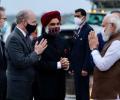
Prime Minister Narendra Modi on Thursday is scheduled to have as many as eight meetings, including with Vice President Kamala Harris, on the first working day of his current US trip.

External affairs minister S Jaishankar on Tuesday discussed issues relating to Afghanistan and the Indo-Pacific during his bilateral meetings with global counterparts on the sidelines of the annual high-level UN General Assembly session.

The Korean summit, laden with symbolism in everything from the choice of location to the mango mousse for dessert, could just be the first round in a continuing dialogue, says Dr Rajaram Panda.

Quad leaders are also planning to roll out vaccine deliverables and announce a series of measures in the field of healthcare and infrastructure sector, officials in Washington, DC said.

Modi had given his maiden address to the UN General Assembly as Prime Minister in 2014.
United States Secretary of State Hillary Clinton, in opening the first-ever US-India Higher Education Summit at Georgetown University in Washington, DC, -- which she co-chaired with Minister of Human Resource Development Kapil Sibal -- declared that while collaboration in this sphere is a driving force in the strategic dialogue between Washington and New Delhi, whether it will ultimately succeed or not depends on those outside government -- academia, researchers, and business
